As electric vehicles become a common sight on Caerphilly streets, many homeowners are looking to upgrade their properties with a dedicated home charging point. Getting a reliable EV charger installed at your property needs more than just plugging it in; it requires professional electrical work to ensure safety, efficiency, and compliance with the latest regulations. When you need certified electricians in Caerphilly for this crucial upgrade, understanding the process and choosing the right installer is vital.
Bringing an electric vehicle charger into your home means preparing your electrical system for a significant new load. It’s not simply a matter of finding a spare plug socket. A dedicated EV charger, often referred to as an Electric Vehicle Supply Equipment (EVSE), draws a substantial amount of power, typically between 3.6kW (16 Amps) and 7.4kW (32 Amps) for most domestic installations. This power draw needs careful consideration of your existing consumer unit, earthing arrangements, and the capacity of the main incoming supply to your property.
For residents in Caerphilly, the diverse range of properties, from older terraced houses to modern new builds, each presents its own unique electrical considerations for an EV charger installation. Older homes might require significant upgrades to their consumer unit to accommodate the new circuit and ensure it meets current safety standards like the 18th Edition Wiring Regulations. Newer homes, while often having more modern electrical systems, still need a thorough assessment to confirm capacity and optimal cable routing.
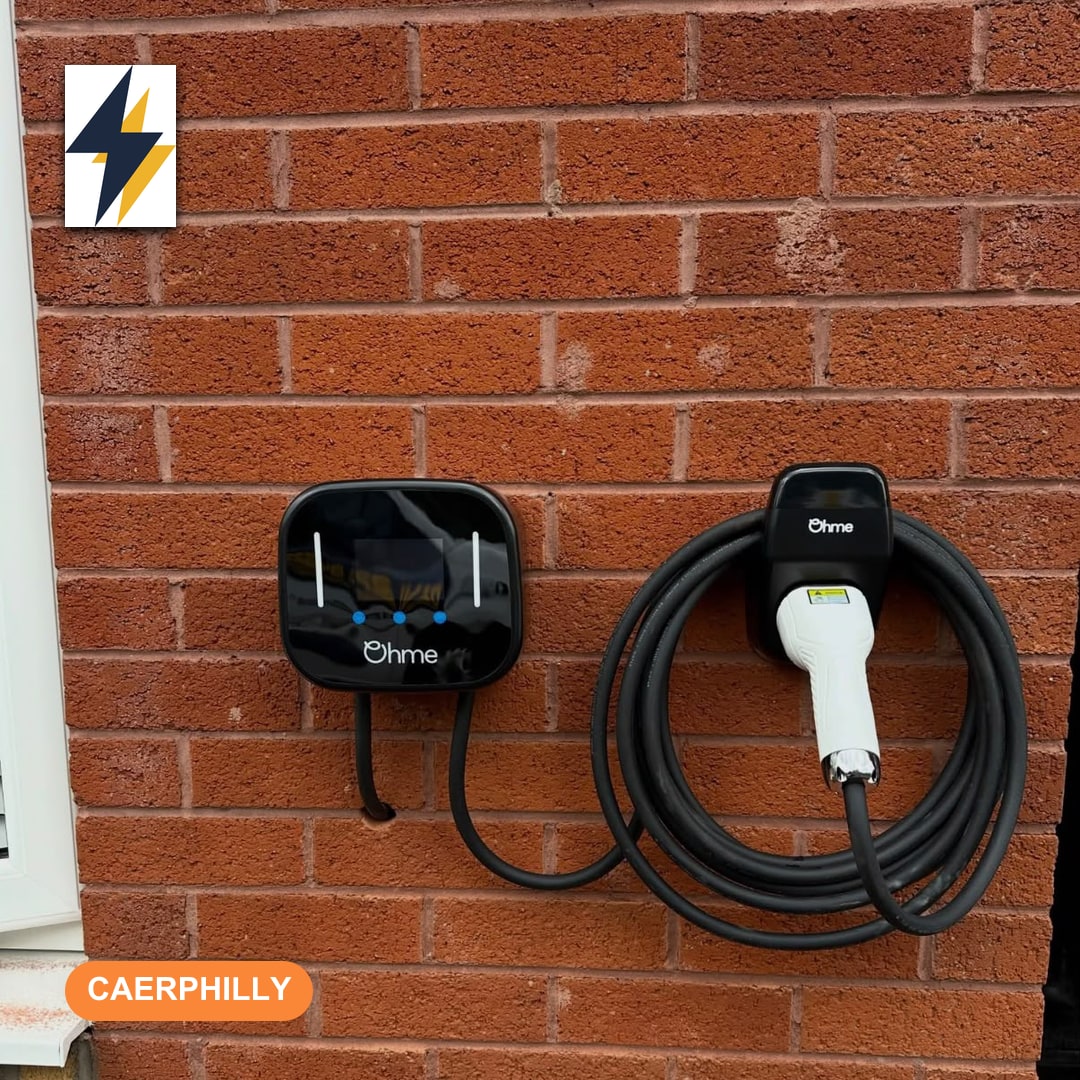
A professional electrical survey by experienced Caerphilly electricians is the essential first step. This survey assesses your home’s existing electrical infrastructure, including the main fuse rating, the condition of your consumer unit, and the earthing system. It also considers the proposed location of the EV charger, ensuring it’s practical, accessible, and safe, whether mounted on an exterior wall, like the Ohme charger pictured, or within a garage. Our NICEIC registered electricians will provide a clear picture of any necessary preparatory work, such as consumer unit upgrades or earth rod installations, before the charger itself can be fitted. This detailed assessment helps prevent unexpected issues during the installation and ensures long-term reliability.
Why Install a Home EV Charger?
The convenience of charging your electric vehicle at home cannot be overstated. Imagine waking up each morning to a fully charged car, ready for your commute or daily errands around Caerphilly and beyond, without needing to detour to a public charging station. This routine not only saves time but can also be more cost-effective, especially when utilising off-peak electricity tariffs.
Beyond convenience, home charging offers a degree of control that public charging often lacks. You can monitor your charging sessions, schedule them for specific times to take advantage of cheaper rates, and have peace of mind that your vehicle is charging safely and efficiently with your own dedicated unit. This level of autonomy is a major draw for EV owners and significantly enhances the overall experience of owning an electric vehicle.
Future-proofing your home is another compelling reason. As the adoption of EVs continues to grow, having a home charging point will become an increasingly desirable feature for properties. Whether you plan to stay in your home for years or consider selling in the future, an EV charger adds significant value and appeal, making your property more attractive in a rapidly evolving market.
Understanding Different Home EV Charger Options
The market for home EV chargers offers a variety of choices, each with different features and capabilities. Typically, domestic chargers are either 3.6kW (taking around 8-12 hours for a full charge, depending on battery size) or 7.4kW (reducing full charge time to 4-6 hours). The choice often depends on your vehicle's charging capabilities, your daily driving needs, and your home’s existing electrical capacity.
Chargers can be either 'tethered' or 'untethered'. A tethered unit, like the Ohme charger in the image, has a cable permanently attached to the unit, offering maximum convenience as you simply plug and unplug. Untethered units require you to use your car's charging cable, which some prefer for flexibility or if they have multiple EVs with different connector types.
Many modern EV chargers are 'smart chargers'. These units connect to your home Wi-Fi and offer advanced features such as:
- Remote scheduling: Start and stop charging from your smartphone.
- Tariff integration: Automatically charge when electricity prices are lowest.
- Energy monitoring: Track your charging history and costs.
- Load balancing: Smart chargers can monitor your home's total electricity consumption and adjust the charging rate to prevent overloading your main fuse, a critical safety feature for many homes.
When considering options for your Caerphilly property, our electricians can advise on the best type of charger to suit your vehicle, your lifestyle, and your home's electrical setup. We work with various reputable brands, ensuring you get a reliable and efficient charging solution.
The EV Charger Installation Process: What to Expect
Installing an EV charger is a significant electrical undertaking that must be carried out by a qualified and certified electrician. Here's a breakdown of the typical process:
- Initial Consultation and Site Survey: We begin with a detailed discussion about your needs, your vehicle type, and your charging preferences. Then, our electricians will visit your Caerphilly property to conduct a thorough electrical survey. This involves inspecting your consumer unit, main earthing and bonding, main fuse size, and assessing the best route for the new cable from your consumer unit to the proposed charger location. We also check for any obstructions and ensure the installation complies with all relevant building and electrical regulations.
- Quotation and Planning: Following the survey, you'll receive a detailed, transparent quotation outlining all costs, including the charger unit (if supplied by us), labour, and any necessary electrical upgrades. We'll discuss the proposed installation plan, including cable routing (e.g., surface mounted, chased into walls, or trenched underground if required for detached garages).
- Preparation Work: Before the charger unit is installed, any necessary preparatory electrical work is completed. This often involves:
- Charger Installation: Once the electrical preparations are complete, the EV charger unit is securely mounted in the agreed-upon location. The dedicated cable is then connected, ensuring all wiring is neat, tidy, and fully compliant with regulations. Our electricians take pride in their clean work, making sure the final aesthetic is as pleasing as its functionality.
- Testing and Commissioning: After installation, the entire circuit and the charger unit itself undergo rigorous testing. This includes insulation resistance tests, earth fault loop impedance tests, and functional checks to ensure the charger is operating correctly and safely. We verify that all safety features are working as intended.
- Certification and Handover: Upon successful completion of all tests, we issue an Electrical Installation Certificate (EIC) or a Minor Electrical Installation Work Certificate (MEIWC) as appropriate, confirming that the work meets all UK safety standards. We'll then demonstrate how to use your new EV charger and answer any questions you might have. As Part P registered electricians, we will also notify the local building control authority of the work, ensuring full compliance.
Cost Factors for EV Charger Installation
The cost of installing an EV charger at your Caerphilly home can vary significantly based on several factors:
- Type of EV Charger: Smart chargers with advanced features generally cost more than basic models. Tethered units can sometimes be slightly more expensive than untethered ones.
- Existing Electrical System: This is often the biggest variable. If your consumer unit needs upgrading, or if your main incoming fuse needs to be uprated by your Distribution Network Operator (DNO), these costs can add up. Older properties in Caerphilly are more likely to require such upgrades.
- Cable Run Length and Complexity: The distance from your consumer unit to the proposed charger location, and how complex the cable routing is (e.g., through walls, under floors, or externally in conduit), will affect labour and material costs. A long, complicated run requiring trenching will naturally be more expensive.
- Earthing System: If your existing earthing system needs improvement or an earth rod installation, this will add to the overall cost.
- Additional Features: Surge protection devices (SPDs) are often recommended for new circuits, and while they add a small cost, they offer valuable protection to your electronics.
While exact prices cannot be given without a site survey, typical domestic installations in the UK, assuming a reasonably straightforward setup, might range from £800 to £1,500. More complex installations requiring significant electrical upgrades or extensive cable routing could be higher. Always ask for a detailed, itemised quote.
Choosing the Right Electrician in Caerphilly
Entrusting your EV charger installation to just anyone can lead to safety hazards and non-compliant work. When selecting electricians in Caerphilly, look for:
- NICEIC Registration: This accreditation ensures that the electricians have been assessed to the highest standards, are regularly checked, and their work complies with all relevant regulations. Our business is NICEIC registered, providing you with confidence in our skills and safety standards.
- Part P Registered: Part P of the Building Regulations ensures that electrical work in homes is designed and installed to be safe. As Part P registered electricians, we can self-certify our work, saving you the hassle and cost of involving local authority building control directly.
- Public Liability Insurance: Always ensure your electrician holds valid public liability insurance. This protects you and your property in the unlikely event of damage or injury during the installation process. We are fully public liability insured for your peace of mind.
- Experience with EV Chargers: While all electricians are qualified, specific experience with EV charger installations means they are familiar with the unique requirements, regulations (like specific earthing solutions for EV chargers), and common issues.
- Clear Communication and Quotations: A reputable electrician will provide a clear explanation of the work required, transparent pricing, and be happy to answer all your questions.
Don't compromise on safety or quality. Investing in a properly installed EV charger by qualified professionals ensures your peace of mind and the long-term reliability of your charging solution.
Common Mistakes to Avoid
When planning your EV charger installation, be aware of these common pitfalls:
- Underestimating Electrical System Needs: Many homeowners assume their existing wiring can handle an EV charger. Without a professional survey, you might discover issues mid-installation that cause delays and extra costs.
- Ignoring Regulations: Electrical work, especially with high-power circuits, is heavily regulated. Attempting DIY or hiring an unqualified individual risks non-compliance, insurance issues, and dangerous electrical faults.
- Poor Cable Routing: Messy or unprotected external cabling looks unsightly and can be damaged over time. A professional will ensure neat, protected, and discreet cable runs.
- Not Considering Future Needs: Think about your next EV. Will it have a larger battery or faster charging capability? Planning for a slightly higher capacity charger now might save you from needing another upgrade later.
- Going for the Cheapest Option: While budget is important, choosing the lowest quote without verifying qualifications, insurance, and the scope of work can lead to shoddy workmanship, safety risks, and ultimately, more expensive repairs down the line.
By avoiding these common mistakes and choosing experienced electricians, you ensure your EV charger installation is a smooth, safe, and worthwhile investment for your Caerphilly home. We're here to guide you through every step.
Frequently Asked Questions
How long does it take to install an EV charger?
A standard home EV charger installation, assuming your existing electrical system is suitable, typically takes a single day. More complex installations requiring consumer unit upgrades or extensive cable routing might take two days.Do I need a special type of consumer unit for an EV charger?
It depends on your current consumer unit. It must be modern, compliant with the 18th Edition Wiring Regulations, and have sufficient spare capacity for a new dedicated circuit for the EV charger. If not, an upgrade will be necessary.Can I install an EV charger myself?
No, installing an EV charger is complex electrical work that carries significant safety risks if not done correctly. It must be carried out by a qualified and certified electrician, as it falls under Part P of the Building Regulations.What are the ongoing costs of owning an EV charger?
The main ongoing cost is the electricity consumed by your vehicle. There are no significant maintenance costs for the charger itself, although smart chargers may have optional subscription services for advanced features.Is my Caerphilly home’s electricity supply strong enough for an EV charger?
Our initial site survey will determine if your home's main fuse can support the extra load of an EV charger. In some cases, an application to your Distribution Network Operator (DNO) may be required to upgrade your main fuse, though this is less common for standard 7.4kW home chargers.What kind of warranty do you offer on EV charger installations?
We provide a warranty on our workmanship, and the EV charger unit itself typically comes with a manufacturer's warranty, often between 2 to 3 years. We’ll provide you with all relevant documentation.Ready to power up your electric vehicle from the comfort of your home in Caerphilly? Get in touch with us today to discuss your EV charger installation needs.
https://www.cardiff-electricians.co.uk/